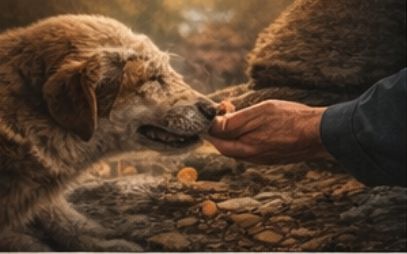
Moral responsibility rarely announces itself in dramatic form. It emerges instead in the ordinary—in the unnoticed gesture, the small decision, the refusal to look away.
Our relationship with animals belongs precisely to this category.
It is not, in most cases, a matter of life and death. It is a matter of posture.
Aquinas situates moral responsibility within the rational capacity to order action toward the good. Animals, lacking this capacity, do not bear moral obligation. They cannot be unjust. They cannot fail ethically.
We can.
This asymmetry is often misunderstood. It is taken either as justification for indifference or as a call to collapse the distinction altogether. But neither response is adequate.
Responsibility arises not because animals are equal to us.
It arises because they are not.
To encounter a being that can suffer, that depends, that exists within our sphere of influence—and to possess the capacity to respond—creates obligation.
This is not sentimental.
It is structural.
In regions marked by instability—Lebanon, parts of the Holy Land, and even within urban Iran—this moral structure becomes visible in stark ways. Stray animals move through the same spaces shaped by human conflict. They are not participants in it, and yet they bear its consequences.
And still, there are those who care.
Shelters such as Pardis Animal Shelter, founded not out of ideology but out of response, exist precisely because individuals refuse to treat suffering as invisible.¹
This matters.
Not because such acts “save the world,” but because they reveal something about what it means to inhabit it rightly.
The Christian tradition does not frame care for animals as an end in itself. It is not the highest moral good. But neither is it trivial. It forms part of a broader orientation—one that recognizes that creation is not ours to disregard.
There is a tendency to ask whether animals have rights.
A more precise question may be whether we have duties.