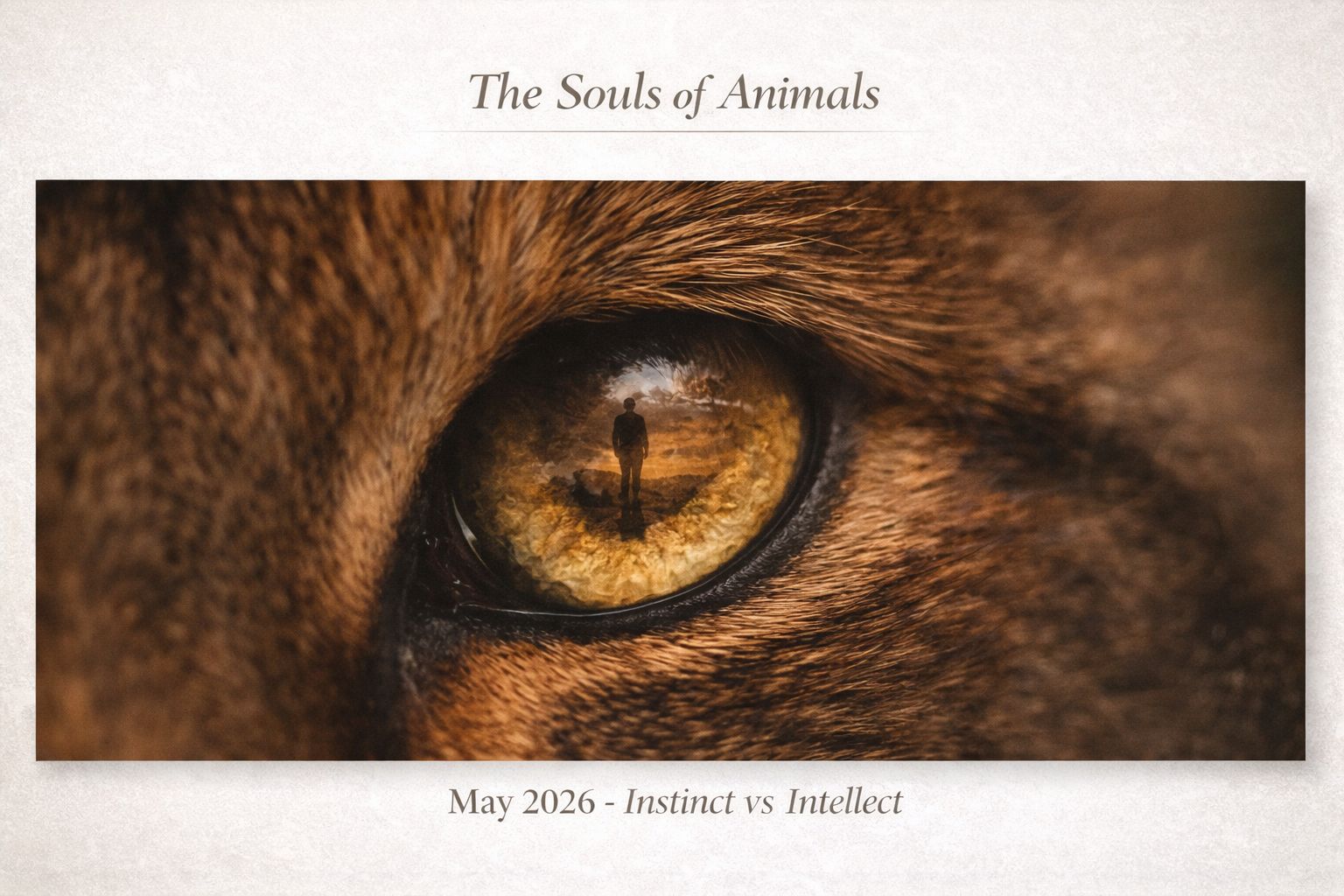
The distinction between human and animal is often asserted more confidently than it is understood.
We speak of intelligence, of language, of reason—as though these form a clean boundary. But lived experience complicates this. Animals solve problems. They anticipate. They adapt. They even appear, at times, to deliberate.
Where, then, is the line?
For Aristotle, the distinction rests in the type of soul: vegetative, sensitive, rational. Animals possess a sensitive soul—they perceive, they desire, they move. Humans possess all of these, but also the rational soul: the capacity for abstraction, for universals, for truth not tied to immediate experience.
Thomas Aquinas refines this further. Animals can know particulars. They can recognize patterns. They can even appear to reason—but what they lack is intellect in the strict sense: the ability to grasp being as such.
This is not merely a difference in degree.
It is a difference in kind.
And yet, the modern impulse is to collapse this distinction—to see human cognition as simply a more complex version of animal cognition. Neuroscience, behavioral studies, and evolutionary continuity all contribute to this flattening.
But something resists it.
Not because animals are less than we are, but because human knowing operates in a different register. We do not merely respond to the world. We step back from it. We ask not only what this is? But what does it mean that it is?
No animal asks this.
No animal contemplates existence as existence.
And yet, animals are not mechanical.
They occupy a middle ground that is often misunderstood precisely because it is neither rational nor reducible to automation. Their instinct is not blind in the sense of being chaotic. It is structured, directed, coherent.
Instinct is a kind of embedded intelligibility.
It does not need to know itself in order to function.
In this way, animals reveal something about creation that is easy to miss: that not all order requires self-awareness. Not all meaning requires reflection.
There is a kind of knowing that does not know that it knows.
And perhaps this is why the presence of animals unsettles us, intellectually. They are close enough to us to mirror aspects of our own behavior, but distant enough to resist assimilation into our categories.
They are not us.
But neither are they nothing like us.