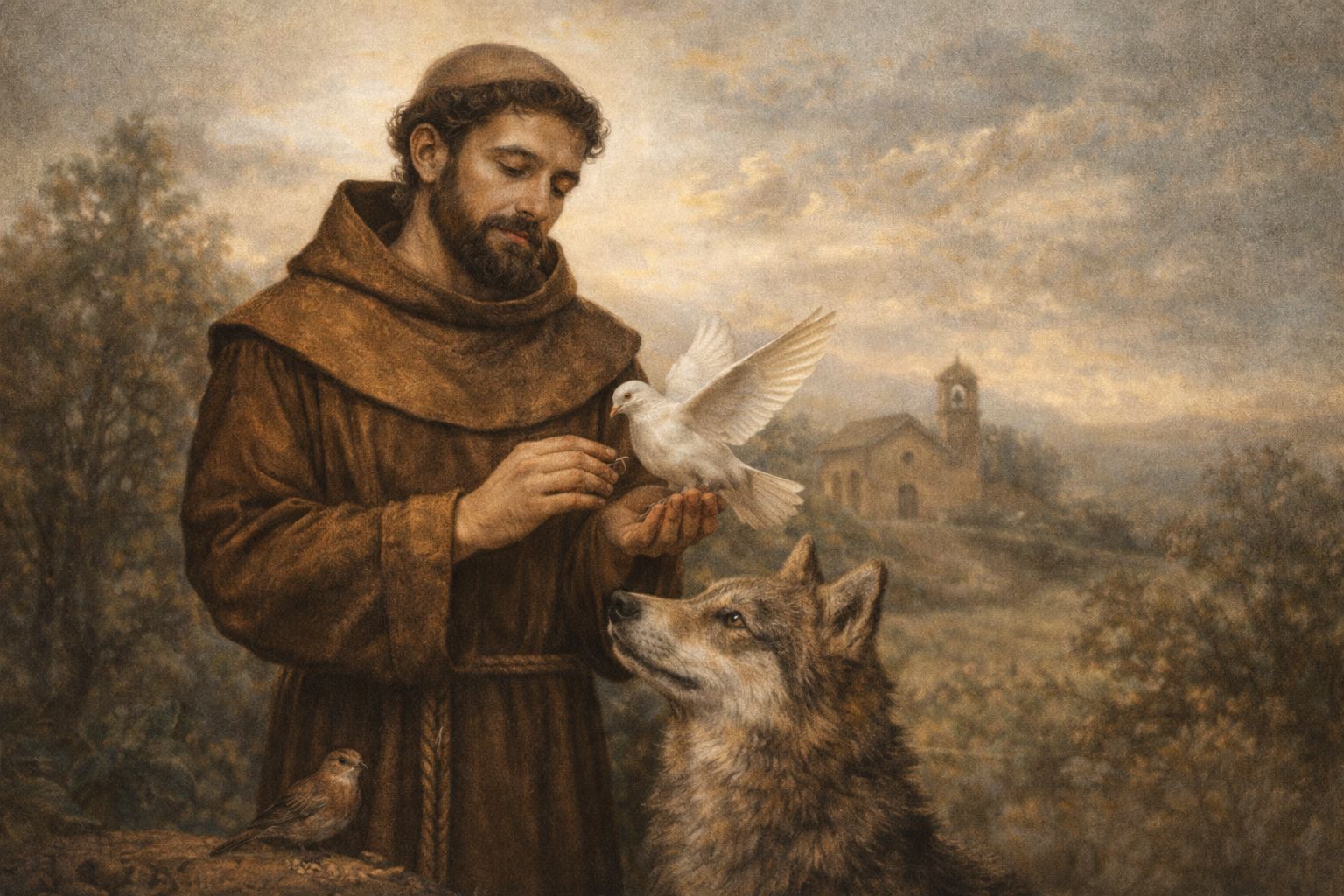
Francis of Assisi is often invoked in discussions of animals.
Too often, he is simplified.
Reduced to a figure of gentleness, of pastoral sentiment, of uncomplicated harmony with nature. Birds gather. Wolves soften. The world responds.
But Francis is not simple.
He is radical.
His relationship with animals does not emerge from affection alone. It emerges from a reordering of his understanding of creation itself. He does not approach animals as objects of care, nor as extensions of human need, but as fellow participants in a created order that is not centered on him.
This is difficult.
It requires a decentering that is not intuitive.
Francis does not erase hierarchy. He does not deny the distinction between human and animal. But he refuses to interpret that distinction as domination.
Instead, he reframes it as kinship—not in equality, but in origin.
All creation shares a source.
And this shared origin carries implications.
To call animals “brother” and “sister,” as Francis does, is not metaphor alone. It is an attempt to articulate a relationship that is neither ownership nor abstraction.
It is an attempt to live within creation without standing outside it.
This is not romantic.