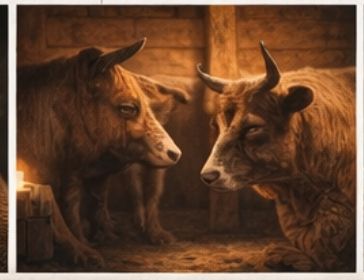
The Gospel accounts of the Nativity are striking in their restraint. There is no mention of animals in the texts themselves. And yet, from the earliest centuries, Christian imagination has placed them there—an ox, a donkey, silent witnesses to the Incarnation.
Why?
Because even in silence, creation recognizes its Creator.
The presence of animals in the stable is not theological necessity, but theological truth expressed symbolically. The ox and the donkey, long associated with labor and humility, stand as representatives of the created order—unadorned, unknowing, and yet present.
They do not speak.
They do not understand.
And yet, they are there.
This presence carries weight. It suggests that the Incarnation is not an event confined to humanity alone. It is an entry into creation itself—into flesh, into matter, into the world shared by all living beings.
The animals do not worship in the way the Magi do. They do not proclaim as the angels do. But they participate through proximity. Through being.
And this, perhaps, is their form of praise.
In a world that often measures worth through intellect, language, and agency, the animals in the stable remind us of another mode of existence—one that does not strive, but receives.
They are not outside the story.
They are within it.
And if the birth of Christ marks the beginning of redemption, then that redemption does not exclude the rest of creation. It begins in a place shared with animals. It unfolds in a world sustained by them. And it points toward a restoration in which all creation is made new.
The stable is quiet.
But it is not empty.