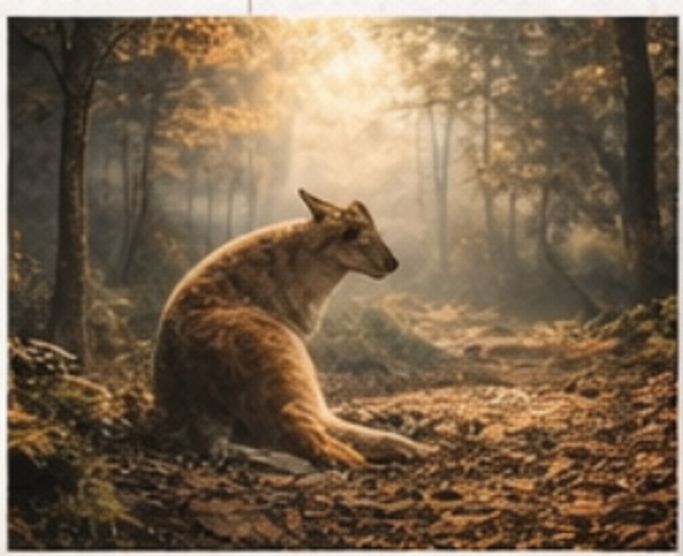
There is a question that appears simple but resists simplicity: why animals?
Not how they evolved, nor how they function within ecosystems, but why they exist at all—within a creation that, in theological terms, proceeds from intention rather than accident.
Within the framework of Thomas Aquinas, nothing in creation is superfluous. God does not create redundantly. Each being participates in existence according to its form, its capacities, and its place within the order of being. This is not merely hierarchy—it is intelligibility.
Animals, then, are not an intermediate step between matter and man. They are not failed rational beings, nor incomplete persons. They are fully what they are intended to be.
And yet, their existence introduces tension.
They suffer. They perish. They exist in a cycle of consumption and vulnerability that, when viewed through a purely human moral lens, appears almost disordered. One could ask: if creation is good, why is it structured in such a way that life depends upon the death of other life?
The classical response is not to deny this, but to situate it within a broader metaphysical claim: goodness is not uniformity. It is multiplicity ordered toward unity.
A world composed only of rational beings would be less full, not more. The richness of creation lies precisely in its gradations—in the presence of beings that perceive without reasoning, that move without deliberation, that live without self-reflection. These are not deficiencies. They are modes of existence.
Aristotle, though writing outside the light of Revelation, grasped something essential: that nature does nothing in vain. The animal, in its instinct, in its movement, in its patterned life, expresses a kind of internal intelligibility that does not require self-awareness to be real.
But Christianity goes further.
Creation is not merely ordered—it is sustained. It is not simply set in motion; it is held in being. And if this is so, then the existence of animals is not only functional but relational. They exist not just within an ecosystem, but within a created order that reflects something of its Creator.
Not consciously. Not deliberately. But truly.
To say that animals exist “for us” is an impoverished account. It reduces their being to utility. Yet to say they exist entirely apart from us ignores the relational fabric of creation in which human stewardship is not incidental, but assigned.
We stand, uneasily, between dominion and responsibility.
Animals exist, then, not as surplus, nor as mere resource, but as participants in a creation that is neither chaotic nor excessive. They fill out the world in a way that reveals its coherence.
A creation without animals would not simply be emptier.
It would be less intelligible.